Plan a route, not a list of pins
Choose an area you can assess realistically and confirm the current access rules with the land manager. A place appearing on a map or social feed does not establish public access. Check opening arrangements, temporary closures, photography restrictions and whether an organized group needs permission. This guide supplies no verified route or live condition report.
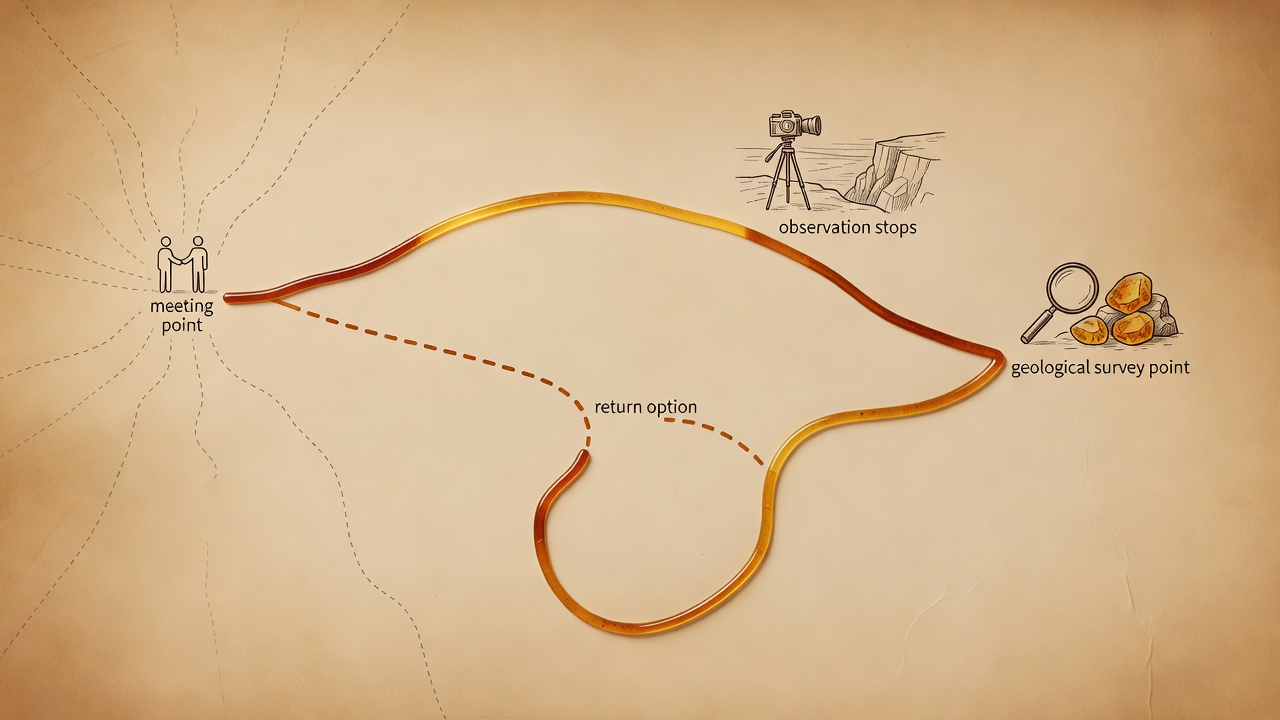
Describe the route in practical terms: surface, approximate distance, gradients, gates, steps, seating and available facilities. Verify the details rather than relying on a generic “easy” label. Build a shorter return option and a place where participants can complete equivalent prompts without covering the full route. Ask what information people need to make their own participation decisions.
- Check official access notices and a current weather forecast.
- Identify a clear meeting point and a fallback meeting point.
- Confirm boundaries, rest opportunities and a turnaround time.
- Write down the local emergency arrangements and site contact.
- Share a cancellation method that does not depend on this website.
Brief people before departure
Explain the mission, finish time, stopping rules and what to do if someone becomes separated. Keep the group size within what the organizer can responsibly manage. Nominate a contact person and an agreed regrouping procedure, while making clear that phones and reception may fail. Do not present the website as a monitoring or rescue service.
Tell participants that images of other people require consideration and, where appropriate, permission. Discuss whether photographs will remain within the group or be shared publicly. Give anyone who does not want to be photographed an uncomplicated way to say so. For children, follow applicable safeguarding requirements and the responsible organization’s consent procedures.
Match the format to the people
Offer a manageable number of prompts and let teams choose an order within the approved area. Do not make the activity a race between locations. A stationary observation team should be able to contribute as fully as a walking team. Rotate creative roles when useful, but do not force a person into a task that conflicts with their access needs.
Ask about adjustments privately and focus on practical arrangements rather than diagnoses. A spoken description, an assistant-operated camera or a sequence selected from an accessible stopping place can meet the same learning goal. Share these options in the initial briefing so nobody has to negotiate an exception in front of the group.
Printable ledger / three missions
Use a small, transparent scorecard
For each criterion, award 0 when it is not demonstrated, 1 when it is partly demonstrated and 2 when it is clearly demonstrated. A full score is 6 per mission and 18 across three missions. These are suggested workshop rules, not a formal photography standard. Agree them before starting and use the same interpretation for every team.
Team: ____________________ Date: ____________________
| Mission | Brief 0–2 | Intent 0–2 | Observation 0–2 | Total /6 |
|---|---|---|---|---|
| 1. __________________ | ______ | ______ | ______ | ______ |
| 2. __________________ | ______ | ______ | ______ | ______ |
| 3. __________________ | ______ | ______ | ______ | ______ |
| Combined score | ____ /18 | |||
- Brief: The response connects clearly to the assigned prompt.
- Intent: The team explains a deliberate visual or descriptive choice.
- Observation: The team gives a specific, honest account of what it noticed.
Do not score camera cost, species rarity, distance traveled or willingness to take risks. Safety, lawful access and wildlife care are participation conditions. If a response involved a breach, stop and address it; do not let attractive photographs compensate for the problem. Give the team a safe alternative where appropriate.
Review without turning it into a contest of confidence
Give teams equal presentation time and offer a written or spoken explanation. Ask the same questions of each: What did you notice? What choice did you make? What would you change? If judges disagree, return to the stated criteria instead of inventing a new preference after seeing the work.
Allow ties. A collaborative recognition such as “clearest observation” can be more useful than forcing a single winner. If you add awards, do not make personal image sharing or public posting a condition of receiving them. Keep the purpose of the outing larger than the score.
Close the outing deliberately
Account for the group at the agreed finish point and confirm any arrangements for returning shared equipment or files. Remove temporary materials you brought and leave the place as you found it. Ask one short question about the format so a future outing can be easier to join.
Organizer note: what if conditions change?
Shorten, relocate or cancel the activity when the actual conditions do not match the plan. Explain the decision plainly. A sheltered image discussion is a better fallback than pressuring a group to continue an unsuitable route.
Organizer note: should teams use a location app?
It is not required. A printed brief and agreed meeting arrangements may be enough. If you choose a third-party app, explain its separate privacy terms and keep a non-app participation option.